Industry Insights and News

Freight Pricing Models Explained: Contract, Spot, Index-Linked and Dedicated (and When Shippers Should Use Each)

Scott Ludewig
September 18, 2026
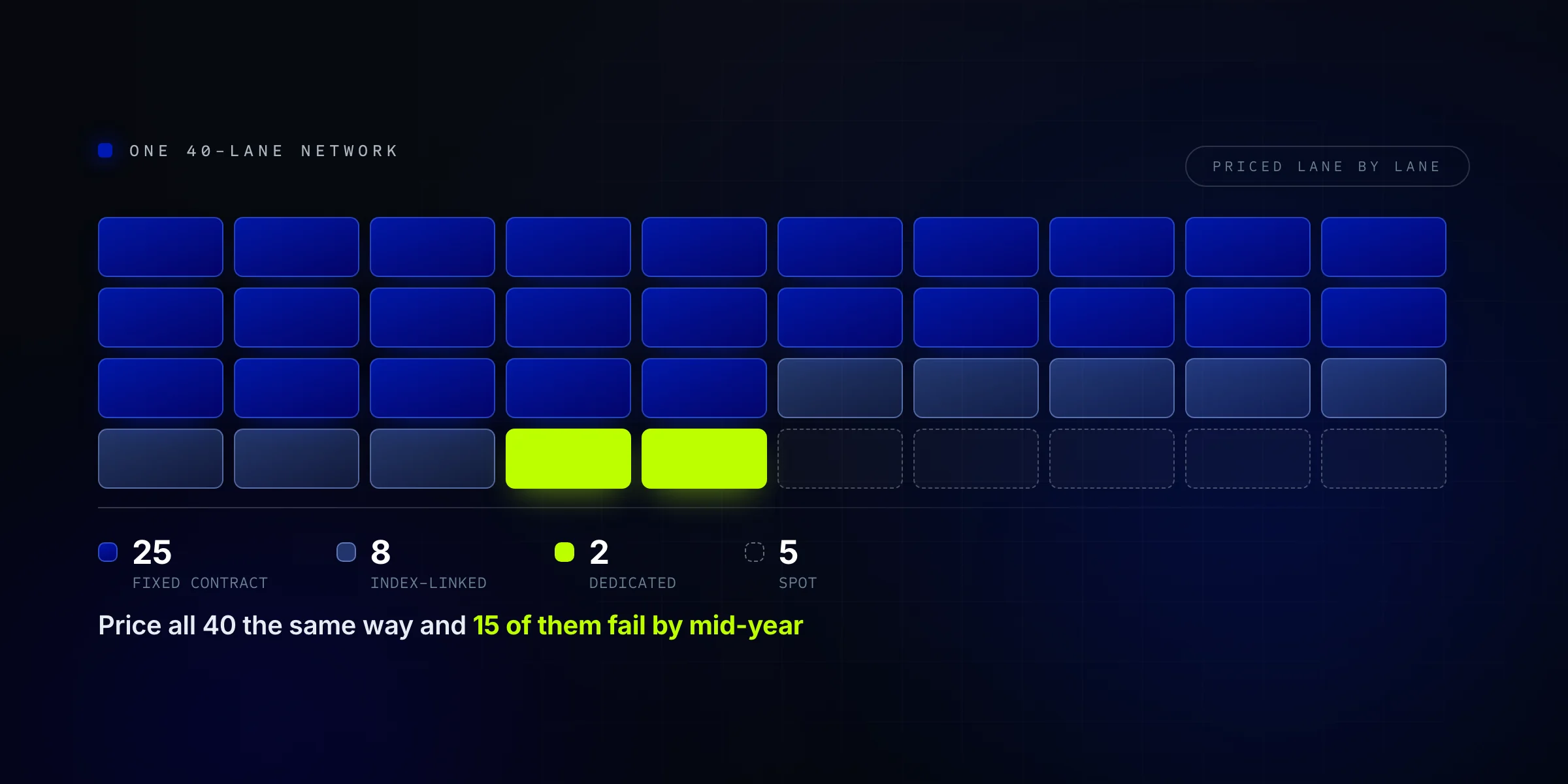
Freight pricing models across a 40-lane network: 25 lanes on fixed contract, 8 index-linked, 2 dedicated, 5 spot

Updated September 2026

A freight pricing model is the rule that decides how a rate is set for a lane: fixed for a year, taken from the market on the day, tied to an index, or bundled into dedicated capacity. The model matters more than the rate itself, because it decides how your cost moves when the market moves.

This guide explains the five pricing models shippers use for truckload and LTL freight, how pricing differs by mode, what the 2026 market is doing to contract and spot rates, a lane-by-lane rule for choosing a model, and how to benchmark a rate before you sign it.

‍

What is a freight pricing model?

‍

A freight pricing model is the agreement between a shipper and a carrier on how a rate is calculated and how long it holds. Two shippers can pay the same rate on the same lane in January and have completely different costs by June, because one signed a fixed contract and the other signed an index-linked one. The rate is the number. The model is what happens to that number when fuel, capacity and demand change.

That distinction matters more in 2026 than it has for several years. Large freight brokers expect truckload spot rates to run 20 to 25 percent above prior-year levels through the rest of 2026, according to forecasts reported by Transport Topics in June 2026. In a market like that, a fixed contract rate signed in a soft market stops being honored: carriers reject the tender and the load moves at spot anyway. Choosing the right model per lane is how shippers keep their budget and their coverage at the same time.

‍

The five freight pricing models shippers use

‍

Most shipper networks use more than one of these at once. Each model below has the same five parts: how it works, what it is good at, where it fails, which lanes it suits, and what to watch.

1. Fixed contract rates

A fixed contract rate is a lane-level rate agreed for a set term, usually twelve months, through an annual RFP or a mini bid, and loaded into a routing guide.

  • How it works: the shipper tenders loads to the primary carrier at the contract rate; if the carrier rejects, the load moves to the next carrier in the routing guide, then to spot.
  • Good at: predictable budgets, planning, carrier commitment on stable lanes.
  • Where it fails: when the spot market rises above the contract rate, carriers reject tenders and the real cost becomes the spot cost. When the market falls, the shipper overpays for the rest of the term.
  • Best for: lanes with consistent weekly volume and moderate rate volatility.
  • Watch: tender acceptance, not just the rate. A low contract rate with poor acceptance is a spot rate in disguise.

2. Spot rates

A spot rate is a one-time price for a single load, quoted at the time of shipment from the current market.

  • How it works: the shipper requests quotes from carriers or a marketplace for one load and awards the best one that day.
  • Good at: irregular freight, new lanes without history, covering loads the routing guide could not.
  • Where it fails: cost swings with the market, no capacity commitment, more work per load. In a rising market spot is the most expensive way to move regular freight.
  • Best for: lanes that ship a few times a quarter, project freight, overflow.
  • Watch: how many of your "contract" loads are actually moving at spot after rejections. If you are comparing spot quotes in a spreadsheet, our guide to freight quoting software shows a faster way.

3. Index-linked contracts

An index-linked contract, sometimes called dynamic or market-based pricing, sets the rate as a published market index for the lane plus or minus an agreed spread, and resets it on a schedule.

  • How it works: shipper and carrier agree on the index (a benchmark lane rate from a data provider), the spread (for example, a fixed dollar amount or percentage above or below the index), the reset cadence (monthly or quarterly) and optionally a floor and a ceiling. The rate moves with the market inside those limits.
  • Good at: keeping carriers committed when the market rises, because the rate rises with it; keeping costs down when the market falls, without a rebid.
  • Where it fails: budgets vary month to month, the index has to be one both sides trust, and the contract needs governance so resets are applied correctly.
  • Best for: high-volume lanes with volatile rates, where fixed contracts keep failing in one direction or the other.
  • Watch: which index, how often it resets, and whether a floor and ceiling are set. A contract with no ceiling in a rising market is a spot contract with extra paperwork.

4. Dedicated or fleet pricing

Dedicated pricing buys capacity, not loads: the shipper pays for trucks and drivers assigned to its freight, usually as a weekly or monthly fixed cost plus a mileage charge.

  • How it works: the carrier commits equipment and drivers to the shipper's network for a term of one to three years, and the shipper pays whether or not every truck is full every day.
  • Good at: guaranteed capacity, consistent service, driver familiarity with sites, protection from spot volatility.
  • Where it fails: empty days and empty miles are the shipper's cost. Long commitments are hard to unwind if volume drops.
  • Best for: dense, repeatable, service-critical freight, such as daily runs between a plant and a distribution center or deliveries with strict appointment penalties.
  • Watch: utilization. A dedicated fleet running at 60 percent utilization costs more per load than a good contract rate.

5. Blended or hybrid pricing

A blended model uses different pricing on different lanes and different tiers of the routing guide: fixed contracts on the stable core, index-linked contracts on the volatile lanes, dedicated capacity on the critical runs, and spot for the rest.

  • How it works: the network is segmented by lane characteristics and each segment gets the model that fits, reviewed at every RFP and adjusted with mini bids in between.
  • Good at: matching cost behavior to each lane instead of forcing one model on all of them.
  • Where it fails: it takes data and discipline. Without lane-level benchmarks and acceptance tracking, the segments drift and the routing guide decays.
  • Best for: any shipper with more than a handful of lanes.
  • Watch: review cadence. A blend set once a year is a fixed contract with extra steps.

‍

How is freight priced by mode?

‍

The pricing model decides how the rate moves. The mode decides how the rate is built in the first place.

  • Truckload: priced per mile or as a flat rate per lane, plus a fuel surcharge and accessorials such as detention, layover and stop-off charges. Volume on the lane and the balance of freight in and out of each market drive the base rate.
  • Less-than-truckload (LTL): priced by freight class, weight, distance and carrier tariff, with minimum charges, dimensional rules and accessorials such as liftgate and residential delivery. Reclassification and reweigh fees can move an LTL invoice more than the base rate does.
  • Parcel: priced by zone, weight or dimensional weight, and service level, plus fuel and accessorials. In the fourth quarter parcel carriers add demand surcharges; our guide to peak season surcharges lists the 2026 dates and fees.

For a line-by-line view of what sits inside a truckload rate, see what really goes into the cost of a truckload shipment.

‍

Contract vs spot rates in 2026: when a contract stops being a bargain

‍

A contract rate is a bargain only while carriers honor it. In 2026 the spot market has moved above many contract rates signed in 2025: broker forecasts of spot rates 20 to 25 percent above prior-year levels (Transport Topics, June 2026) describe exactly the conditions in which contract tenders get rejected. FTR reported that broker-posted spot rates rose for all equipment types in the week ending 4 September 2026, the first time since May, which is the seasonal pattern heading into the fourth quarter.

Cass's Truckload Linehaul Index, which tracks linehaul rates excluding fuel and accessorials, rose 11.3 percent year over year in August 2026, its twentieth consecutive monthly increase (FreightWaves, 14 September 2026). For the most common accessorial fees, with real published carrier rates, see our guide to accessorial charges and how to avoid them.

The signs a contract has stopped working on a lane:

  • Tender acceptance on the lane has fallen below the level the routing guide was built for.
  • A growing share of the lane's loads are moving with backup carriers or at spot.
  • The contract rate sits below the current market benchmark for the lane.

When those signs appear, waiting for the next annual RFP is the expensive option. The faster fix is a targeted rebid of the failing lanes; our freight mini bids guide explains when to run one and how. For the lanes that fail every year, the answer is usually a different pricing model, not a different rate.

‍

How to choose a pricing model lane by lane

‍

Three inputs decide the model for a lane. Score each lane on all three and the model follows.

  • Volume consistency: does the lane ship every week at a predictable volume, or in bursts?
  • Rate volatility: how far does the market rate on this lane swing across the year?
  • Service sensitivity: what does a late or missed pickup cost the business on this lane?

The rule:

  • Consistent volume, stable rate: fixed contract.
  • Consistent volume, volatile rate: index-linked contract.
  • Consistent volume, service-critical, dense enough to fill trucks daily: dedicated.
  • Inconsistent volume: spot, with a preferred carrier list so the quotes come from carriers you know.
  • Everything together: blended, reviewed at every RFP and corrected with mini bids in between.

For example, in a 40-lane network, 25 lanes might ship every week at steady rates (fixed contract), 8 might ship weekly but swing with produce season (index-linked), 2 might run daily into a customer with delivery penalties (dedicated), and 5 might ship a few times a quarter (spot). Pricing all 40 on a fixed contract would fail on 15 of them by mid-year.

‍

How shippers benchmark a rate before they sign

‍

A benchmark is the current market rate for a specific lane, equipment type and time period, drawn from real transactions. It answers the only question that matters before signing: is this rate above, at, or below what the market is paying today?

Two benchmarks matter:

  • Contract benchmark: what shippers are paying on contract for the lane. Use it to judge an RFP bid or a renewal.
  • Spot benchmark: what the lane is moving for on the spot market right now. Use it to see whether a contract rate is about to be rejected and to price index-linked contracts.

Emerge provides DAT-branded rate benchmarking inside the platform, announced in our post on the Emerge and DAT partnership. Contract benchmarking flags the lanes where your rate is out of line with the market, and spot benchmarking shows the live premium on the lanes most likely to fall out of the routing guide. Benchmark before the annual freight RFP, during it to score bids, and monthly afterwards to catch drift.

‍

Freight pricing terms in one place

‍

  • Linehaul: the base charge for moving the freight from origin to destination, before fuel and accessorials.
  • Fuel surcharge: a charge indexed to fuel prices, added to the linehaul.
  • Accessorials: charges for services beyond the move, such as detention, liftgate, residential delivery and stop-offs.
  • All-in rate: linehaul plus fuel plus expected accessorials, the number to compare across carriers.
  • Minimum charge: the lowest amount a carrier will bill for a shipment regardless of size.
  • Tender: the offer of a load to a carrier at the agreed rate, which the carrier accepts or rejects.
  • Routing guide: the ranked list of carriers and rates for each lane.
  • Spread: in an index-linked contract, the agreed amount above or below the index.

‍

Frequently asked questions

‍

What are the different types of freight rates?

The main types are fixed contract rates (set for a term, usually a year), spot rates (quoted per load from the current market), index-linked rates (a market index plus or minus a spread, reset on a schedule) and dedicated rates (a fixed cost for assigned trucks and drivers). Most shippers blend them across their lanes.

‍

Should I use contract or spot rates?

Use contract rates on lanes with consistent volume and use spot for irregular freight. In a rising market like 2026, add index-linked contracts on the volatile high-volume lanes, because fixed contracts on those lanes are the ones carriers reject first.

‍

What is an index-linked freight contract?

An index-linked freight contract sets the rate as a published market benchmark for the lane plus or minus an agreed spread, and resets it monthly or quarterly. It keeps carriers committed when rates rise and lowers cost when rates fall, without a rebid. Agree the index, the spread, the reset cadence and a floor and ceiling before signing.

‍

How often should shippers rebid contract lanes?

Rebid the whole network once a year through the annual RFP, and rebid individual lanes whenever their tender acceptance falls or their rate drifts from the benchmark, using a mini bid that takes days rather than months.

‍

Is freight priced differently for FTL and LTL?

Yes. Full truckload is priced per mile or per lane plus fuel and accessorials. LTL is priced by freight class, weight and distance against a carrier tariff, with minimum charges and dimensional rules. Parcel is priced by zone, weight and service level, with demand surcharges in the fourth quarter. For a full comparison of the two modes, including the density-based freight classes that took effect in July 2025, see FTL vs LTL: what's the difference and when to use each.

Ready to reinvent your procurement strategy?

Book a Demo ->